
The most reliable way to identify dishwasher-safe dinnerware is by the specific manufacturer's instructions and, for tested dinnerware, by a pictogram showing a water jet and a number of wash cycles. The glass-and-fork symbol only indicates food contact. If there are no care instructions, suitability cannot be reliably deduced from the material or appearance; hand washing is then the cautious choice.
1. What symbols indicate suitability for the dishwasher?

A test mark with a stylized water jet and a number is the most concrete indicator. According to the IKW, the number indicates the number of wash cycles that a tested piece of dinnerware has withstood without significant damage in the specified testing procedure. DIN EN 12875-1 describes a reference testing procedure for household items.
| Marking | Meaning | Your decision |
|---|---|---|
| Water jet with number | Tested dishwasher resistance; the number indicates the specified wash cycles. | Additionally observe manufacturer's instructions regarding program and temperature. |
| "Dishwasher-suitable" | Manufacturer's statement without automatically recognizable reference to a specific standard test mark. | Read care instructions and choose a gentle program for delicate surfaces. |
| Glass-and-fork symbol | Marking for food contact according to Article 15 and Annex II of Regulation (EC) No. 1935/2004. | Do not use as proof of suitability for dishwasher, microwave, or oven. |
| No care instructions | Dishwasher suitability is not demonstrably proven for you. | For valuable, old, or decorated items, prefer hand washing. |
2. Is the material alone sufficient for a decision?

No. Neither porcelain nor stoneware nor glass is automatically dishwasher-resistant simply due to the material name. The specific product information is crucial. For decorated items, metallic rims, hand-painted surfaces, cracks, or unknown origin, additional caution is advisable.
| Material | What to check | Be careful with |
|---|---|---|
| Porcelain dinnerware | Care approval, decoration, and possible metal components. | Gold or colored rims, older pieces, and unknown decoration techniques. |
| Stoneware dinnerware | Manufacturer's information, glaze, unglazed areas, and visible cracks. | Damaged glazes and prolonged residual moisture. |
| Glass | Dishwasher approval and secure placement in the rack. | Crystal glass, contact with other glass, and incorrect water hardness settings. |
| Wood or material mix | Information on each material component. | Wood, adhesive bonds, coatings, and delicate handles. |
If you want to compare material effect, haptics, and everyday use, the published guide Stoneware or Porcelain: Which dinnerware suits you? complements this care decision.
3. How do you load dishes gently?

Load dishes so that water reaches all surfaces and the items do not touch each other as much as possible during the program. The exact rack arrangement depends on the appliance; therefore, the instructions in your dishwasher's operating manual take precedence.
After drying, proper storage protects against friction and unnecessary edge pressure. The guide Storing dishes correctly: practical, safe, and ready to hand is relevant here.
4. Which program and setting are correct?

There is no universally best program. Choose the program according to the degree of soiling, the care instructions for the dishes, and the appliance's operating manual. Bosch, for example, points out that water hardness and the water softening system should be correctly set to avoid limescale deposits and damage to glasses.
5. The SÄNGER 30-second check
Our own editorial checklist
This decision-making aid was compiled by SÄNGER for this guide. It is not a documented laboratory or product test.
- Is the dishwasher instruction on the product page, packaging, or underside clear?
- Are there restrictions regarding temperature, program, or basket position?
- Are the glaze, decoration, rim, and base free from visible damage?
- Can the item stand stably in the basket without touching neighboring items?
- Is the water hardness set correctly on the appliance and the spray arm clear?
6. Which SÄNGER dinnerware sets are suitable for everyday dishwasher use?
All complete SÄNGER dinnerware sets can be described as dishwasher-safe. However, the specific product pages remain the authoritative source for material, scope of delivery, and further care instructions.

SÄNGER Aruba Combi-Service, 30 pieces
Stoneware dinnerware set for six people. The official product description states dishwasher usability.
View Aruba Dinnerware Set
SÄNGER Bilgola Dinner Service, 24 pieces
Porcelain dinnerware set for six people. The official product description labels the set as dishwasher-safe.
View Bilgola Dinnerware SetFrequently asked questions about dishwasher-safe dinnerware
How can I tell if dinnerware is dishwasher-safe?
Check the specific manufacturer's instructions. For tested glass, ceramic, enamel, and plastic dinnerware, a water jet symbol with a number may indicate the specified wash cycles. If there is no care information, hand washing is the cautious choice.
Is "dishwasher-suitable" the same as "dishwasher-safe"?
No. "Dishwasher-suitable" is a manufacturer's statement. The IKW technically uses "spülmaschinenfest" (dishwasher-proof) for tested cutlery and "spülmaschinenbeständig" (dishwasher-resistant) for appropriately tested dinnerware made of glass, ceramic, enamel, or plastic.
What does the glass-and-fork symbol mean?
It designates materials or articles intended to come into contact with foodstuffs. The symbol does not automatically confirm suitability for dishwashers, microwaves, or ovens.
Can stoneware go in the dishwasher?
Stoneware can go in the dishwasher if the specific manufacturer information confirms it. Additionally, check the glaze, rims, and visible damage, and place the item stably in the rack.
Which program best protects dishes?
That depends on the dishes, the degree of soiling, and the appliance. Observe the care instructions for the dishes and the dishwasher's operating manual; for delicate glasses, a dedicated glass program may be advisable.
Sources and References
- DIN Media: "DIN EN 12875-1:2005-08 – Dishwasher resistance of articles – Part 1: Reference test method for domestic articles", Publication date 08/2005. URL: https://www.dinmedia.de/en/standard/din-en-12875-1/81768883.
- German Cosmetic, Toiletry, Perfumery and Detergent Association (IKW): "Spülmaschinenbeständig oder spülmaschinenfest? (Dishwasher-resistant or dishwasher-proof?)", June 2019. URL: https://www.ikw.org/fileadmin/IKW_Dateien/downloads/Haushaltspflege/Spuelmaschinenbestaendig_oder_spuelmaschinenfest.pdf.
- European Union / EUR-Lex: "Regulation (EC) No 1935/2004 on materials and articles intended to come into contact with food", consolidated version of 27.03.2021, Article 15 and Annex II. URL: https://eur-lex.europa.eu/legal-content/DE/TXT/PDF/?uri=CELEX%3A02004R1935-20210327.
- Robert Bosch Hausgeräte GmbH: "New dishwasher: First use done right with the Bosch Quick Start Guide", Date not specified, retrieved on 04.08.2026. URL: https://www.bosch-home.com/de/bosch-erleben/magazin/haushaltstipps/geschirrspueler-quick-start-guide.
- Bluespoon GmbH / SÄNGER: "SÄNGER Stoneware Dinnerware Set Aruba, Combi-Service 30 pieces for 6 people", Product information, retrieved on 04.08.2026. URL: https://saenger-geschirr.de/products/saenger-steingut-geschirrset-aruba-kombiservice-30-teilig-fur-6-personen.
- Bluespoon GmbH / SÄNGER: "SÄNGER Porcelain Dinnerware Set Bilgola, Dinner Service 24 pieces for 6 people", Product information, retrieved on 04.08.2026. URL: https://saenger-geschirr.de/products/saenger-tafelservice-bilgola-aus-porzellan-24-teilig.

Mara Stein
Expert for table culture, recipes, and product knowledge at SÄNGER. Mara combines material knowledge, everyday experience, and sense of style to help you choose, combine, and care for dinnerware more easily.
Mara Stein's author profile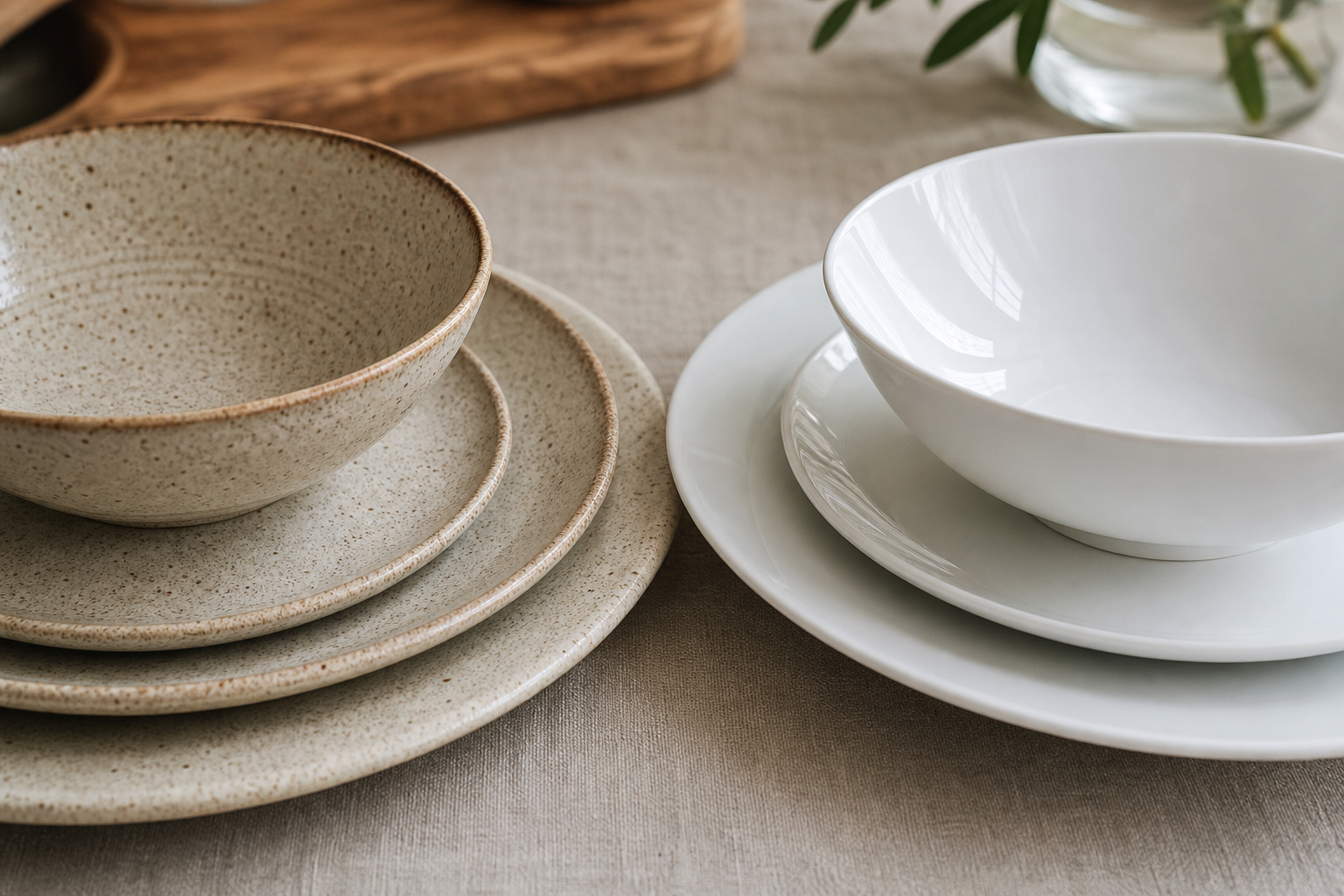

Leave a comment
This site is protected by hCaptcha and the hCaptcha Privacy Policy and Terms of Service apply.